

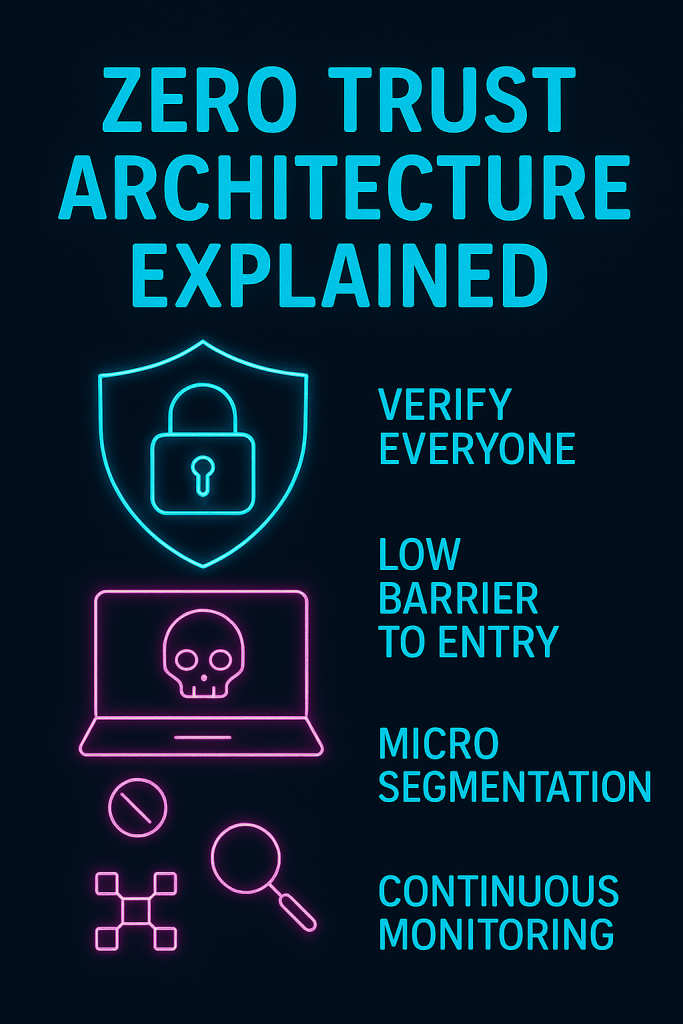
Zero Trust Architecture Explained
In today’s digital-first world, traditional perimeter-based security models are no longer enough. With cloud adoption, hybrid workforces, and AI-driven threats reshaping the landscape, organizations are turning to Zero Trust Architecture (ZTA)—a modern framework built on the principle of “never trust, always verify.”
🔑 What is Zero Trust Architecture?
Zero Trust assumes that no user, device, or application—whether inside or outside the network—can be implicitly trusted. Every access request must be verified, monitored, and granted only the minimum privileges necessary.
Core principles include:
- Never trust, always verify – Treat all requests as potentially hostile until proven safe.
- Least privilege access – Grant only the permissions needed for a specific task, for the shortest time possible.
- Continuous monitoring – Track user behavior and system activity in real time to detect anomalies.
🧩 The 7 Pillars of Zero Trust (NIST Framework)
According to the latest NIST guidelines, Zero Trust is built on seven interconnected pillars:
- Identity Security – Strong authentication and identity verification.
- Device Security – Ensuring endpoints are secure and compliant.
- Network Security – Micro-segmentation and encrypted traffic.
- Application Security – Protecting apps from unauthorized access.
- Data Security – Classifying and encrypting sensitive information.
- Visibility & Analytics – Real-time monitoring and threat detection.
- Automation & Orchestration – Automated responses to threats.
🌐 Why Zero Trust Matters in 2026
- Cloud-first environments: Multi-cloud adoption demands dynamic, context-aware policies.
- Remote & hybrid workforces: Employees access systems from anywhere, requiring strict verification.
- AI-powered threats: Attackers use automation to bypass traditional defenses, making continuous monitoring essential.
- Regulatory compliance: Privacy and security laws increasingly mandate Zero Trust principles.
🛡️ Implementing Zero Trust: Practical Steps for Businesses
- Adopt MFA everywhere – Secure identities with multi-factor authentication.
- Segment your network – Limit lateral movement by isolating workloads.
- Encrypt data in transit and at rest – Protect sensitive information.
- Monitor continuously – Use analytics and AI-driven tools to detect anomalies.
- Automate responses – Reduce human error and speed up incident handling.
Final Thoughts
Zero Trust isn’t a single product—it’s a mindset and framework for modern cybersecurity. By embracing continuous verification, least privilege access, and real-time visibility, organizations can build resilience against evolving threats. In 2026, Zero Trust is no longer optional—it’s the foundation of secure digital transformation.

 CYBERHELP AFRICA